How One Person Can Manage 10,000+ Mining Rigs - The ItsMiner Strategy
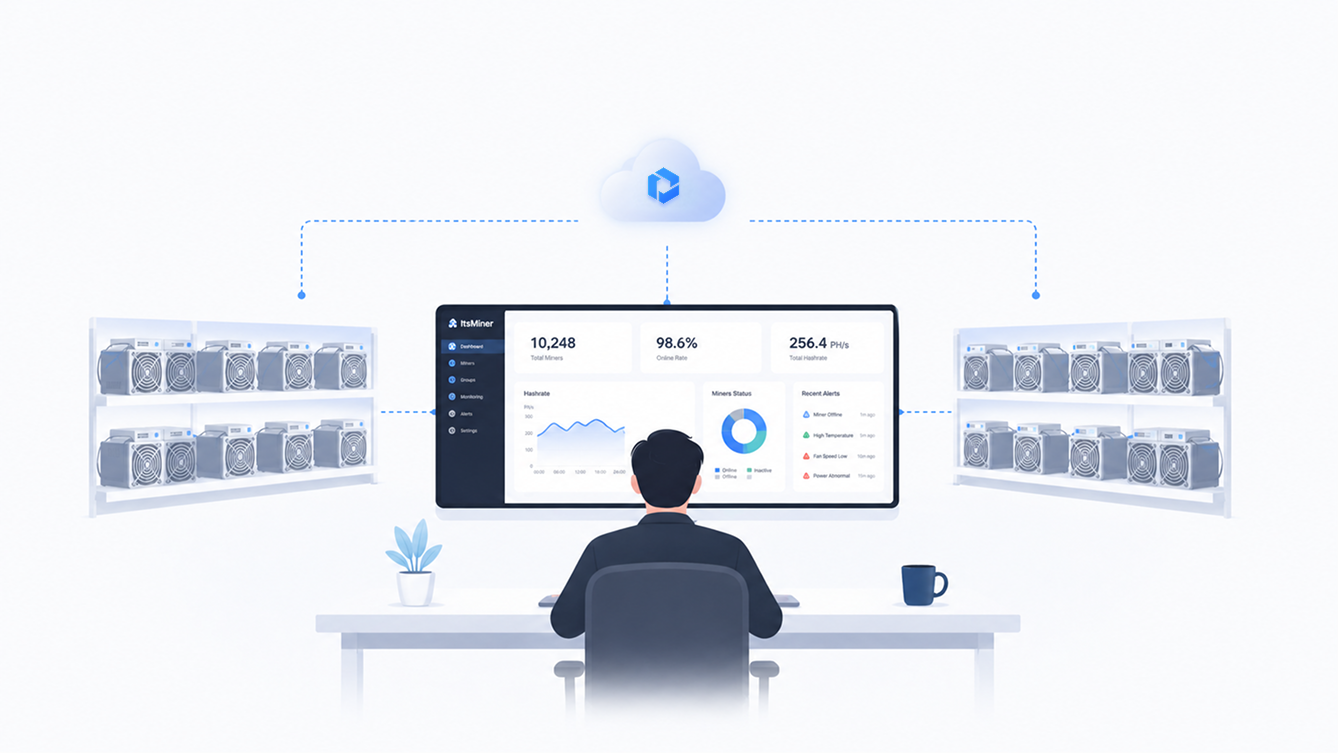
In the early days of Bitcoin mining, a few dozen machines could be managed with a simple spreadsheet and a keen eye for blinking red lights. Today, the scale has shifted dramatically. Managing a 10,000+ rig operation—often spanning multiple megawatts—typically requires a large team of technicians, engineers, and administrators. However, with the emergence of professional full-stack O&M (Operation and Maintenance) platforms like ItsMiner, the paradigm is changing. Established in 2018 and currently managing over 200,000 miners worldwide via its AWS-based cloud architecture, ItsMiner has proven that with the right "Energy Operating System," a single expert can effectively command a massive mining empire.
This blog explores how you can leverage ItsMiner’s core functions to transition from a manual "repairman" to a high-level "system administrator," managing 10,000+ units with unprecedented efficiency.
1. Zero-Touch Deployment: The "Shelve and Mine" Philosophy
The first hurdle in managing 10,000 miners is the initial setup. Manually configuring IPs and pool settings for a fleet of this size would take a team weeks. ItsMiner solves this through its "Shelve and Mine" feature.
The system utilizes a local ItsMiner Monitor Server that sits on your farm’s network, scanning the environment every 5 minutes. Once you rack a new miner and plug it in, the system automatically detects it, applies standardized IP configurations, and pushes the correct pool sub-account settings based on your pre-defined rules. This automation eliminates the need for manual scanning and individual configuration, allowing one person to deploy thousands of units simply by overseeing the physical racking process.
2. Situational Awareness via Dual-Dashboards
When you are responsible for 10,000 machines, you cannot afford to get lost in raw data. ItsMiner provides two distinct views to separate business health from technical performance:
- Management Dashboard : This provides the "Big Picture." You can see the total hashrate, earnings, and electricity consumption across all sites. It aggregates data from both the local miners and the mining pools to provide a Hashrate Compliance Rate. If your pool hashrate is lower than your local hashrate, you know immediately there is a network or pool-side issue without checking a single machine.
- Operations Dashboard: This is your tactical command center. It identifies the Top 10 Faulty Racks and sub-accounts, allowing you to prioritize your efforts. Instead of wondering which of the 10,000 machines needs help, the dashboard tells you exactly where the most significant failures are concentrated.
3. The "Digital Twin" and Visual Inspection
One person cannot walk past 10,000 machines every day. ItsMiner’s Visual Inspection module creates a "Digital Twin" of your mining farm. You can view a graphical map of your facility that displays temperature distributions, fault status, and hashrate density at the rack level.
Using the Heatmap View, a single operator can spot a cooling failure in a specific corner of a warehouse instantly. This allows for "precision strikes" in maintenance—you only go to the rack that the system has flagged as an anomaly, rather than wandering the aisles.
4. Building a Self-Healing Infrastructure
The secret to managing 10,000 miners alone is ensuring that you don't have to fix the small things. ItsMiner’s Automated O&M engine acts as a 24/7 digital watchman:
- Auto-Restart: The system can be configured to automatically restart miners that exhibit low hashrate, high temperature, or high rejection rates 7, 16. You can set specific thresholds (e.g., restart if hashrate drops 20% for 10 minutes) to resolve minor glitches without human intervention.
- High-Temperature Protection: If a miner exceeds safe thermal limits, ItsMiner can automatically switch it to a "Sleep" or "Low Power" mode to prevent hardware damage, and then restore it once temperatures stabilize.
- Sub-account Whitelist: Security is a major concern at scale. ItsMiner automatically monitors sub-account configurations; if a miner is redirected to an unauthorized account (a common sign of firmware viruses), the system identifies the abnormality and automatically restores the correct configuration.
5. Mastering the Micro-Grid: Energy OS and Load Control
At the 10,000-rig scale, power management is as important as hashrate. Whether you are operating on the Texas grid (ERCOT) or using off-grid gas-powered generators, ItsMiner serves as an Energy Operating System.
Through the Load Control module, you can automate your response to volatile energy markets. You can set rules to stop mining when real-time electricity prices exceed a certain threshold and resume when they drop. For those using natural gas, ItsMiner provides millisecond-level closed-loop control between the Genset Controller and the miners. This ensures that the miners’ load automatically follows the generator's capacity, preventing frequency collapses or engine damage. One person can manage the complex interplay between energy generation and consumption through a single automated interface.
6. Closing the Loop: Task Tracking and Asset Lifecycle
Even if you are the sole manager, you might have on-site contractors or a small team for physical repairs. ItsMiner’s Ticket System allows you to track the entire lifecycle of a miner. When a machine fails, it is grouped into a ticket, assigned for repair, and tracked from the rack to the repair bench and back.
ItsMiner even manages your Inventory and Parts You can track how many control boards or fans you have in stock, ensuring that you never face downtime because of a missing $20 part.
Conclusion: From Repairman to Architect
Managing 10,000+ miners is no longer a feat of manual labor; it is a feat of orchestration. By using ItsMiner, one person can oversee the deployment, monitoring, self-healing, and energy optimization of a massive fleet.
The platform's ability to integrate local miner data with pool earnings, while automating response to faults and energy prices, provides the digital leverage necessary to scale. In the modern mining era, the most successful operators aren't those with the biggest crews, but those with the smartest systems.
Subscribe to ItsMiner's Blog
Get the latest posts delivered right to your inbox