Post-Halving Mining Profit, Beyond Hashrate, Adjustable Loads Matter

After the Bitcoin Halving, More Monitoring Data Isn't What Mining Operations Really Need
Following Bitcoin’s halving, mining operations have entered a far more sensitive phase. With the same electricity expenses, hardware and O&M costs, miners generate fewer BTC outputs. In the past, most mining operators expanding mining operations, higher uptime and lower failure rates. While these factors still matter, they are no longer sufficient to sustain competitiveness in the next stage of the industry.
The biggest shift comes from the power market. Electricity price volatility, Demand Response (DR), peak-off-peak price spreads and load curtailment strategies are transforming mining sites from pure hashrate assets into energy loads that require active operational management. A 50MW or 100MW mining facility may track real-time online miner status, yet it cannot turn energy market fluctuations into operational advantages if it fails to stably cut and restore loads amid price spikes or DR notifications, and review the full execution afterward.
The core question post-halving is no longer merely “how much BTC can we mine?” It also becomes: “Can we mine at optimal times, reduce mining load, and verify that every load adjustment is fully implemented as planned?”
From Full-Load Operation to Strategic Dispatch
Traditional mine management mainly focuses on status monitoring: Are miners online? Is hashrate normal? Are temperatures abnormal? Is pool revenue deviating from targets? These tools help operators visibility, yet visibility alone cannot resolve risks stemming from power markets.
Real-time electricity prices can cross preset thresholds within minutes, DR notifications may mandate load reduction within specified time windows, and operation teams may voluntarily adjust part of the mining fleet for scheduled periods. In such scenarios, mines do not require extra charts — they need a way to turn operational strategies into execution.
This is where the Load Control capability delivers value.: it enables mining farms to shift from passive power consumption to flexible load management that is plannable, executable and fully traceable.
| Traditional Operation Logic | Load Control Operation Logic |
|---|---|
| Maintain full load operation as much as possible | Dynamically adjust loads based on electricity prices, DR signals and operational strategies |
| Manual judgment, manual notification and manual restoration | Form closed-loop workflows via configurable tasks, batch execution and recovery rules |
| Only focus on real-time status | Track the full lifecycle including triggers, execution, restoration and audit logs |
| Operational outcomes rely entirely on staff experience | Exportable execution records support post-event business reviews |
Load control is far more than simply reducing miner loads. The real challenges cover multiple dimensions: which miners to adjust, the execution sequence, mechanisms to prevent accidental unintended wake-up, scheduled restoration timing, verification that hashrate rebounds to target levels after recovery, and full transparent records accessible to both management and hosted clients.
Manual Adjustment Hits Its Bottleneck Rapidly
Manual adjustments work for small-scale mining sites. When electricity prices surge, operators notify on-site staff to switch miner operating modes; upon receiving curtailment alerts, teams shut down partial mining rigs; once the restriction window ends, staff restore equipment manually.
Industrial-scale mining operations are significantly more complex. Thousands or tens of thousands of mining rigs are distributed across distinct IP segments, hardware models, sub-accounts and individual hosted client portfolios. Manual selection cannot guarantee consistent adjustment scopes every time. Furthermore, electricity price shifts and DR programs have strict time windows. A delay of several minutes, or restoration postponed by tens of minutes, can materially skew revenue performance assessments.
More critically, manual operations lack complete audit trails. Post-event reviews can only rely on chat logs and verbal recollections, which lack reliability for mines with mines participating in energy markets. Instead of adding more monitoring metrics, most operators urgently need load adjustment capabilities that are fully executable and auditable for business decision-making.
ItsMiner’s Approach: Load Control as the Energy Execution Layer
ItsMiner is a SaaS platform dedicated to Bitcoin mining management and real-time rig monitoring for mining facilities. Its Load Control module is not just an additional energy dashboard — it connects price signals, DR alerts, miner operating modes and execution logs into a complete task closed loop.
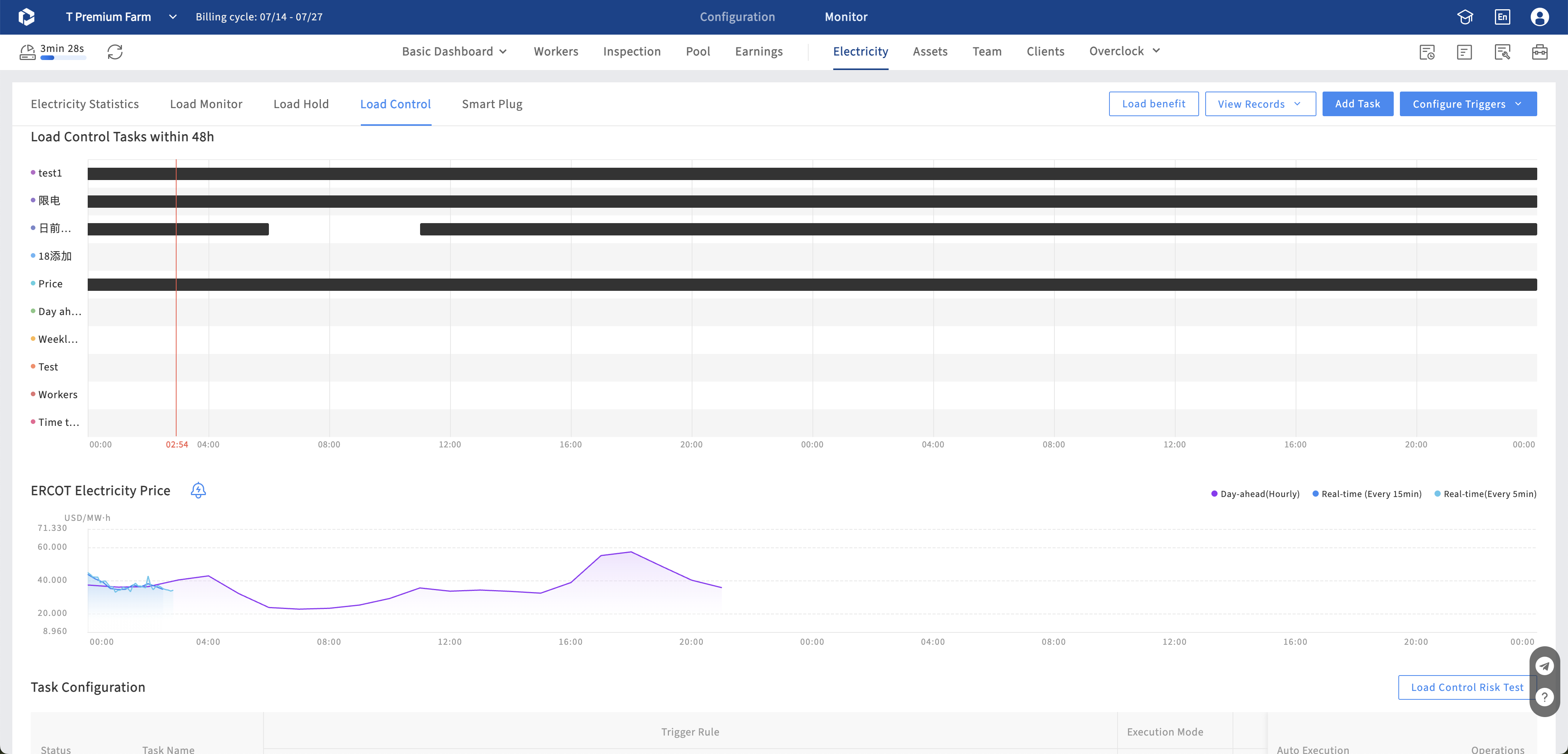
Within ItsMiner, operators can create load control tasks triggered by electricity prices, DR curtailment orders, fixed time schedules, manual instructions, designated miner groups or IP segments. The platform cuts or restores loads by switching miner operating modes, and mitigates operational risks for large-scale deployments through batch execution, custom execution sequencing, wake-up prevention, skip rules for identical operating modes, and recovery strategies for network outages or power failures.
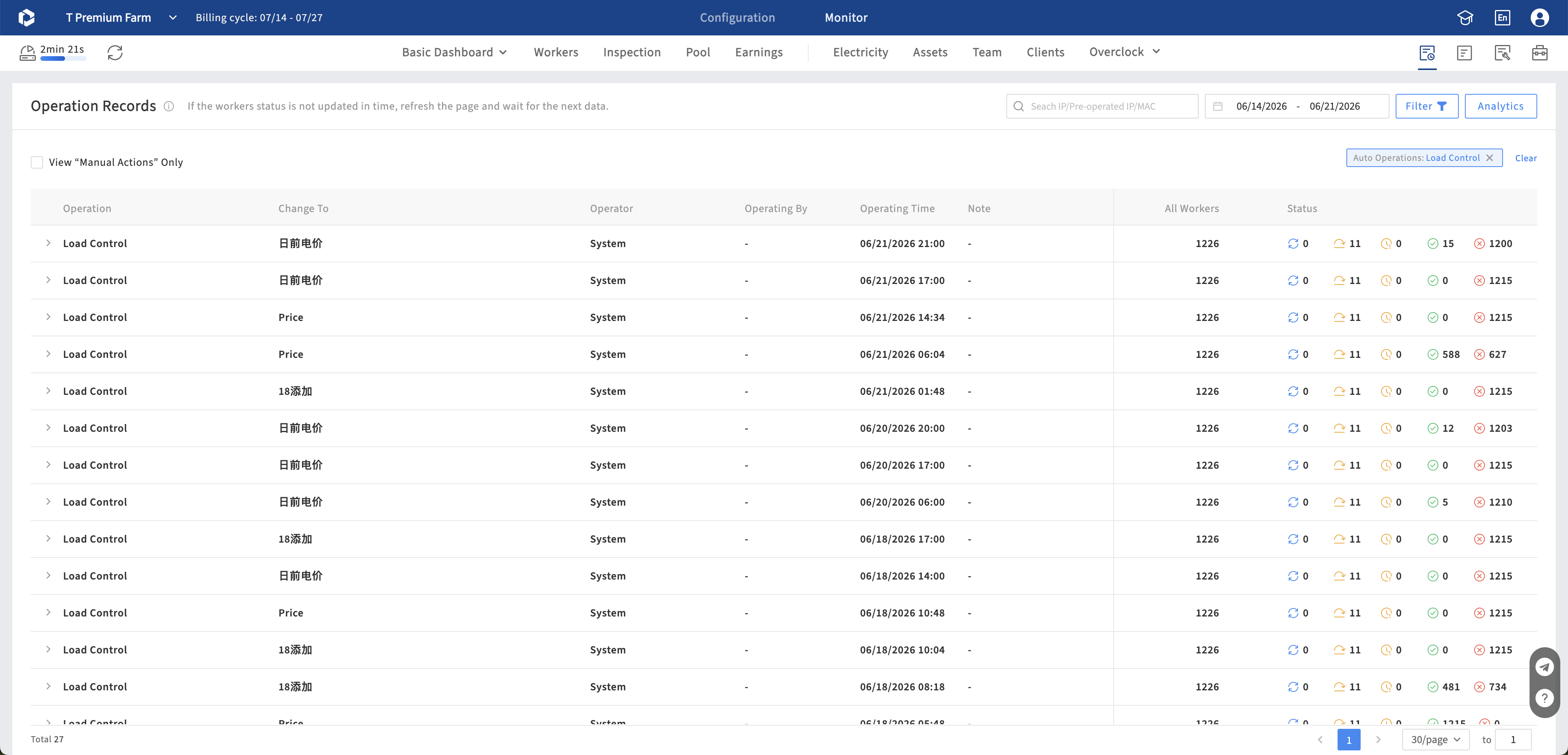
For management teams, audit trails carry equal importance as operational actions. Trigger logs, execution records, dashboard alerts, full operation logs, 48-hour Gantt charts, electricity price curves and exportable data enable comprehensive reviews of every load adjustment: the root trigger reason, planned vs. actual adjusted rig quantities, skipped devices, restoration timelines, and any equipment failures encountered.
Hashrate Remains Fundamental, While Load Flexibility Emerges as a Core Operational Competency
Post-halving, mining operators cannot solely depend on expanding hardware and boosting hashrate to drive profits. Hashrate remains the foundational asset, yet load flexibility is evolving into a core operational capability: mitigating financial risks during high-price periods, responding to DR curtailment signals, ensuring ensuring hashrate returns to target levels to target levels after restrictions, and retaining full audit records of the entire process.
For industrial mining facilities, Load Control is no longer an optional auxiliary feature — it acts as a critical bridge linking on-site rig operations, energy market participation and overall ROI. The real competitive edge doesn't come from seeing more data—it comes from executing better decisions when the power market changes.
Subscribe to ItsMiner's Blog
Get the latest posts delivered right to your inbox